
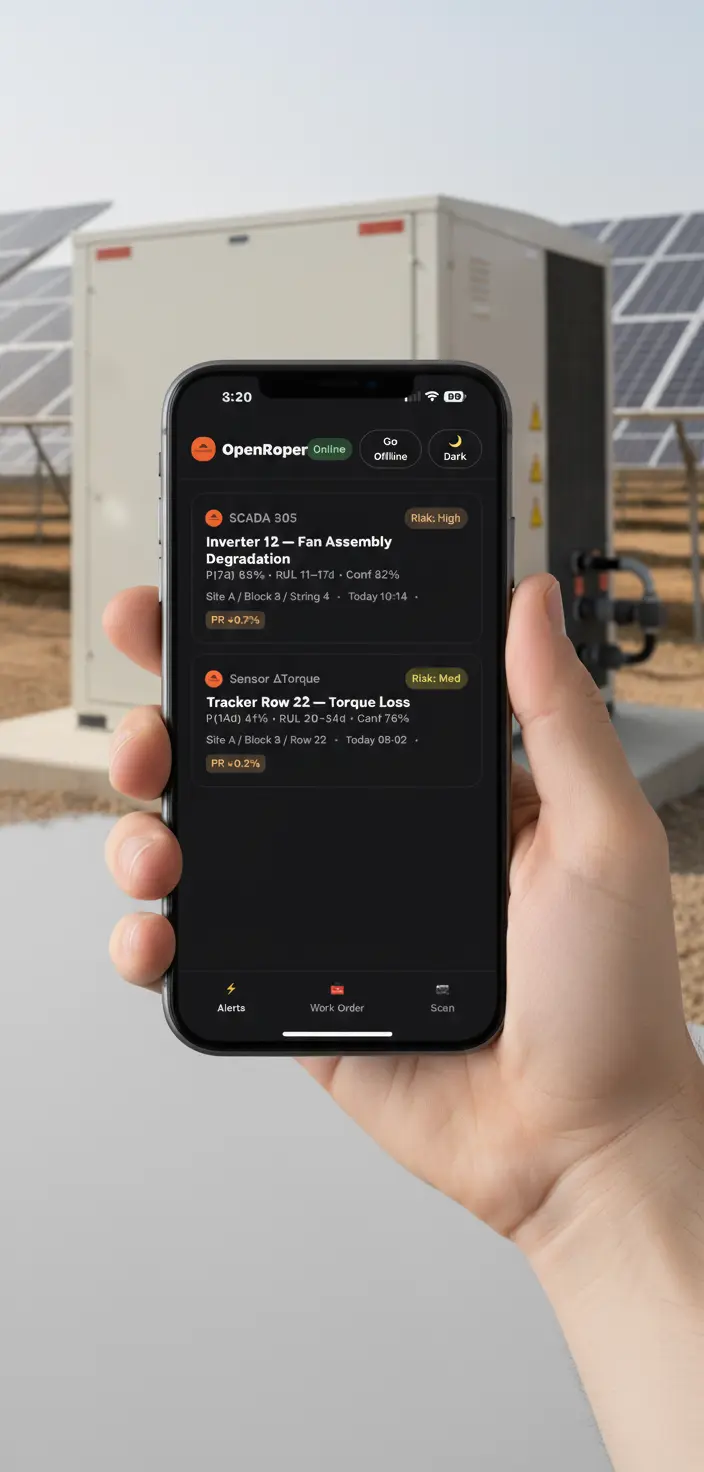
OpenRoper AssistantThe field interface to Forge.
Forge turns your PV and BESS data into performance audits, repower scenarios, and end-of-life economics. OpenRoper brings that intelligence into the field – clarifying faults, suggesting fixes, and tying every truck roll back to avoided downtime and recovered MWh.
Currently in pre-pilot design and validation. We begin with a Forge Solar Performance Audit before deploying OpenRoper.
Operator-owned AI • Built on Forge • Runs alongside your SCADA and CMMS stack.
What does OpenRoper sit on top of?
OpenRoper is not a standalone SaaS tool. It's the assistant layer that sits on top of Forge and your existing stack:
- • Forge audits expose the real performance baseline per site.
- • SCADA and CMMS events describe what's failing and where.
- • Technician notes capture how issues are actually resolved.
- • Repower and decommissioning plans describe where the asset is headed over the next 5–20 years.
What will OpenRoper solve in the field?
- • Cryptic fault codes that slow diagnosis and cause repeat visits.
- • Parts uncertainty that leads to wasted truck rolls and delays.
- • Disconnected SCADA, CMMS, and notes that hide recurring issues.
- • Paper/Excel workflows that add friction and hide the MWh and $ impact of downtime.
Forge makes the lifecycle economics explicit. OpenRoper makes the next field action obvious.
How OpenRoper works with Forge
In pre-pilot design, the workflow is simple: Forge does the heavy analytics; OpenRoper turns that into field-ready actions.
Forge ingests SCADA alarms, CMMS tickets, and audit data. OpenRoper reads from Forge, not directly from every system.
OpenRoper uses Forge’s context (performance, history, parts, risk) to classify issues, suggest root causes, and prioritize by lost MWh and risk.
Field-ready work instructions: steps, tools, parts, safety notes, and links back to CMMS. Every action feeds future Forge audits and Prevention Credits.
Built for PV O&M, anchored in Forge
OpenRoper inherits everything Forge knows about your assets – from SingingWater-scale C&I to utility-scale portfolios – and makes it usable at the inverter, combiner, and breaker.
Work instruction includes required parts, tools, torque specs, and safety callouts based on past resolutions.
Find systemic issues by inverter, combiner, string, or feeder. Prioritize by lost MWh and prevention value.
Cache tickets and steps when connectivity is poor; sync future-state with Forge when back online.
Don’t rip-and-replace. Forge handles SCADA/CMMS integration; OpenRoper consumes that context.
Same controls as Forge: single-tenant, on-prem or operator-controlled cloud, SSO, audit logs.
Translate downtime avoided into $ saved, Prevention Credits, and IRR deltas – all traceable back into Forge reports.
Integrations (through Forge)
OpenRoper doesn't bolt directly onto every system. Forge handles the heavy lift of connecting SCADA, CMMS, and files – OpenRoper reads from that unified layer.
ROI that ties back into Forge
Forge already maps failure types → downtime → lost MWh → $ impact → IRR deltas. OpenRoper turns those models into day-to-day field actions and feeds the results back into future audits.
Numbers are directional targets for pre-pilot design. Actual results will be validated using Forge audits at candidate sites like SingingWater and beyond.
Security & Deployment (shared with Forge)
OpenRoper inherits Forge's deployment and governance model. Same controls, same operator-owned philosophy.
You keep full ownership. Forge and OpenRoper only process the data you choose to share and keep it under your control.
Single-tenant cloud or on-premise Forge node. Air-gapped edge option for sites requiring strict isolation.
SSO, RBAC, audit logs, and least-privilege roles – consistent across Forge and OpenRoper.
Prompt injection defenses, retrieval allowlists, output filters, model version pinning, and full prompt/completion audit trails with human-in-the-loop controls.
OpenRoper starts with a Forge Solar Performance Audit
Before we put an assistant in anyone's hands, we use Forge to understand how your sites are actually performing. Then we design the OpenRoper pilot around real downtime, real faults, and real Prevention Credits.