
OpenRoper TrailMap — Design
Translate the Blueprint into an executable plan. TrailMap defines the pilot scope, risk controls, and adoption plan so the team can prove value safely and convincingly.
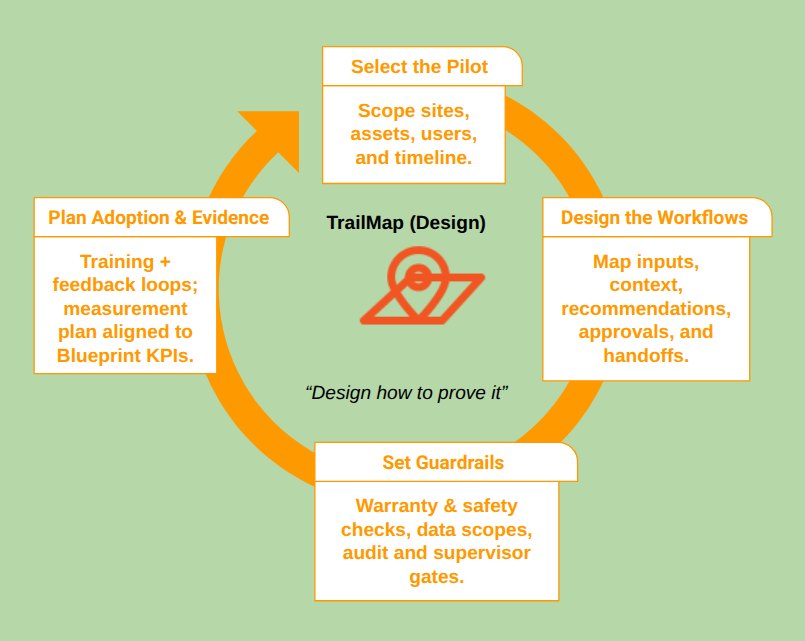
TrailMap anchors the Design phase...turning business intent into a safe, testable plan.
What TrailMap Does
TrailMap takes the KPIs and ROI expectations from Blueprint and designs how, where, and with whom to prove value. It sets the pilot guardrails, specifies workflows, and plans the change management needed for teams to adopt (not just try) the solution.
- Defines pilot scope (sites, assets, users, workflows, duration).
- Maps decision points & handoffs that reduce back-and-forth and first-time-fix gaps.
- Establishes risk & safety guardrails (warranty, approvals, audit trail, data scopes).
- Plans adoption & training with field-friendly instructions and feedback loops.
Inputs & Outputs
Inputs
- Blueprint ROI model, KPI definitions, acceptance criteria.
- Operational constraints: warranty terms, site access, scheduling, IT/security posture.
- Existing artifacts: SOPs, checklists, job logs, vendor SLAs, safety rules.
Outputs
- Pilot plan (sites, staffing, timeline, gates, rollback).
- Workflow specifications (inputs, prompts/context, outputs, approvals).
- Risk & change-management plan (guardrails, comms, training, feedback).
Example Deliverable — Pilot Plan (Excerpt)
Scope
- 2 sites · 45 MW total
- Workflow: Fault triage → Technician checklist
- Users: 8 techs, 2 supervisors
Guardrails
- Read-only CMMS; supervisor approve for escalations
- Warranty flags surfaced before action
- All recommendations logged with provenance
Measurement
- KPIs: MTTR, repeat rolls, doc quality
- Evidence: baseline vs post-pilot deltas
- Finance review cadence: bi-weekly
TrailMap documents exactly how the pilot proves (or falsifies) value with clear go/no-go gates.
Risk & Change Management
Adoption isn’t accidental. TrailMap makes it safe to try and easy to keep, with scoped access, supervisor approvals where needed, and simple training that shortens time-to-value.
- Least-privilege data scopes with auditable access.
- Human-in-the-loop gates for sensitive actions.
- Quick-reference SOPs and embedded checklists.
- Feedback loops to refine prompts, context, and workflows.
What Comes Next
With a clear pilot plan and guardrails in place, the team moves into FieldAssistant...deploying field-intelligence workflows and learning from real operations.